In this article
The three materials in South Florida attics
Almost every South Florida home uses some mix of three duct materials. Flexible duct - a wire helix wrapped in insulation with a plastic jacket - is the branch material in most homes built or renovated since the 1980s. Duct board - rigid fiberglass panels - forms the trunk lines in many 1960s to 1990s homes. Galvanized metal - the oldest and most durable - shows up in pre-1970s construction and commercial work.
Each ages differently, and a single house often has all three generations in the same attic: an original metal or board trunk, flex branches from a later renovation, and a replacement section from the last AC change-out.
Typical service lives, honestly stated
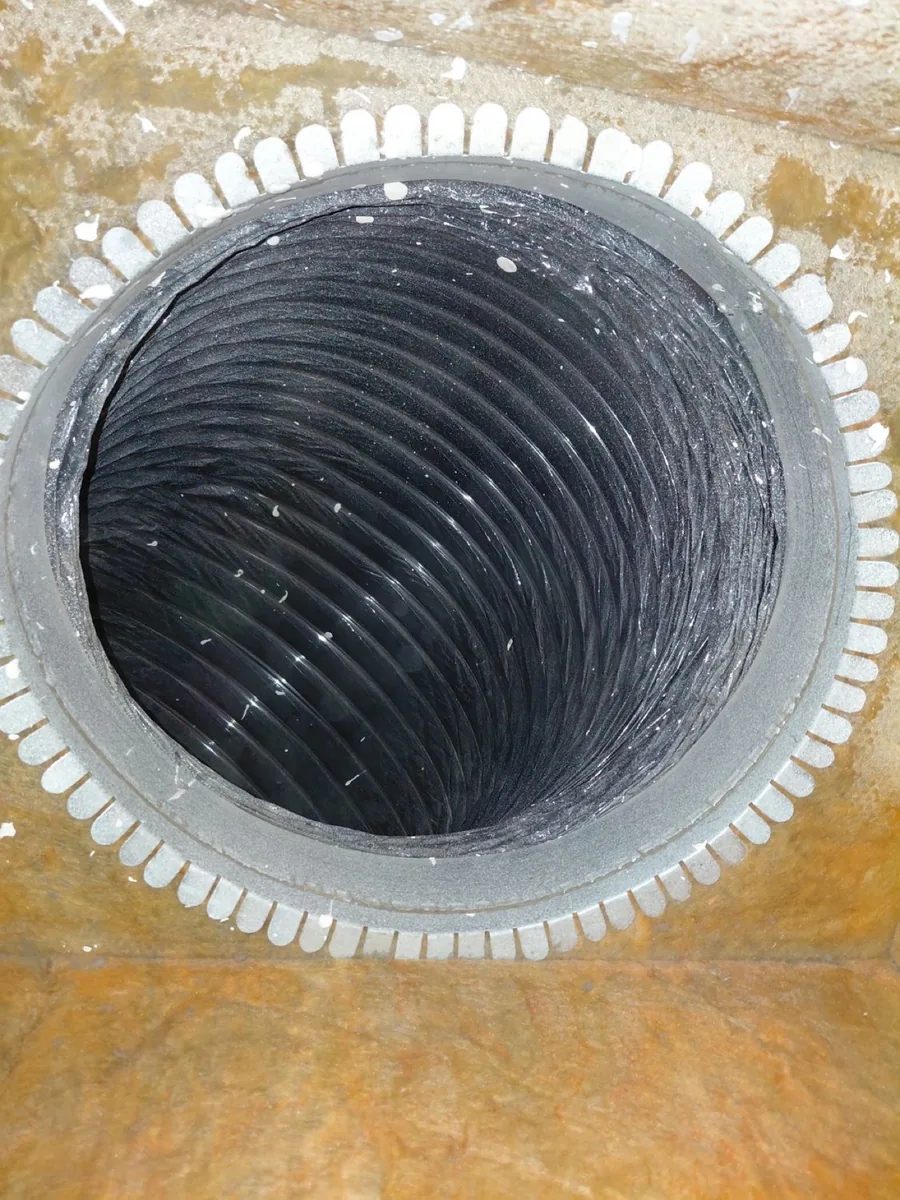
- Flex duct: about 15 to 20 years in a Florida attic before the jacket and inner liner grow brittle, straps cut in, and sags turn into kinks. In a cooler, drier attic it can go longer; in a 140-degree attic over a garage, less.
- Duct board: about 20 to 30 years if it stays dry - its inside lining is the wear surface, and once that coating erodes the clock runs out. Wet duct board can be finished in a single season.
- Galvanized metal: 30 years and well beyond when joints stay sealed. Metal rarely wears out; it leaks at joints and connections instead, which is a repair, not a replacement.
These are service-life ranges for the material, not expiration dates. We regularly clean 30-year-old duct board that is still sound, and we regularly condemn 12-year-old flex that was installed badly and cooked. Installation quality and moisture history move the number more than the birthday does.
What shortens duct life in Florida
- Attic heat. Sustained 130 to 150 degree attic temperatures bake plastic jackets and dry out tapes, mastics, and duct board coatings years ahead of schedule.
- Moisture. Condensation on under-insulated runs, roof leaks, and drain backups soak insulation and board. Wet is the fastest path to failed ductwork - and to mold growth inside it.
- Pests. Rodents and raccoons shred flex duct for nesting material and open board at joints.
- Poor support. Flex duct strapped too far apart sags; sags collect condensation and choke airflow, and every service visit that steps near a run can crush it further.
- Salt air. Near the coast, metal components, straps, and screws corrode, and joints open as their fasteners fail.
Signs the ductwork itself is at the end
Dirty ducts and worn-out ducts feel similar from the living room - dust, weak airflow, uneven rooms - but they are different problems. Ductwork is reaching its end when the lining is eroding or flaking, when runs are crushed or disconnected in several places, when joints leak everywhere instead of somewhere, when sections have been wet, or when the layout itself was undersized for the house from the start.
Cleaning fixes exactly one thing: what is sitting inside sound ducts. It cannot re-line a trunk, un-crush a run, or enlarge a return. Our replace-or-clean guide is the full framework we use to separate the two, and the fiberglass duct board guide covers the most common Florida case in depth.
What extends duct life
Keep it dry, keep it supported, and leave it alone. Fix roof and drain leaks before they reach the ducts. Keep insulation intact and attic access work careful around runs. Change filters on schedule so the system is not straining against its own ductwork. And when sections do fail, replace sections - a duct system renewed run by run can serve indefinitely, the way most of South Florida’s older housing stock actually does.
When replacement is the answer, it is quoted like everything else we do: after a free hands-on inspection, as one exact price in writing, for air duct replacement of exactly the sections that need it - including at AC replacement time, when the work is easiest to fold in.
Frequently asked questions
How long do flex ducts last?
About 15 to 20 years in a typical Florida attic. Heat is the main enemy - the plastic jacket and inner liner grow brittle, straps cut in, and unsupported spans sag into kinks. Flex installed with proper support in a dry attic can outlast the range; flex that has been crushed, wet, or chewed can fail in half of it.
Can ductwork be repaired instead of replaced?
Often, yes. Leaking metal joints can be resealed, a crushed flex run can be swapped on its own, and a failed duct board section can be rebuilt while the sound sections stay. Replacement of the whole system is for when failures are widespread - eroded lining throughout, moisture damage in many runs, or a layout that was undersized from the start.
Does old ductwork affect a new AC?
Directly. A new system is sized assuming the ducts deliver its air; leaking, crushed, or undersized ducts mean warm rooms, long cycles, and a blower working against restrictions from day one. That is why the ducts deserve an assessment in writing before any replacement install.
How do I know if my ducts are duct board or flex?
Look in the attic: duct board runs are rigid, rectangular, and usually silver-faced or dull gray panels forming straight trunk lines. Flex duct is round, soft, and silver or black jacketed, and it bends. Many homes have both - a board trunk with flex branches. An inspection identifies every run and its condition.