In this article
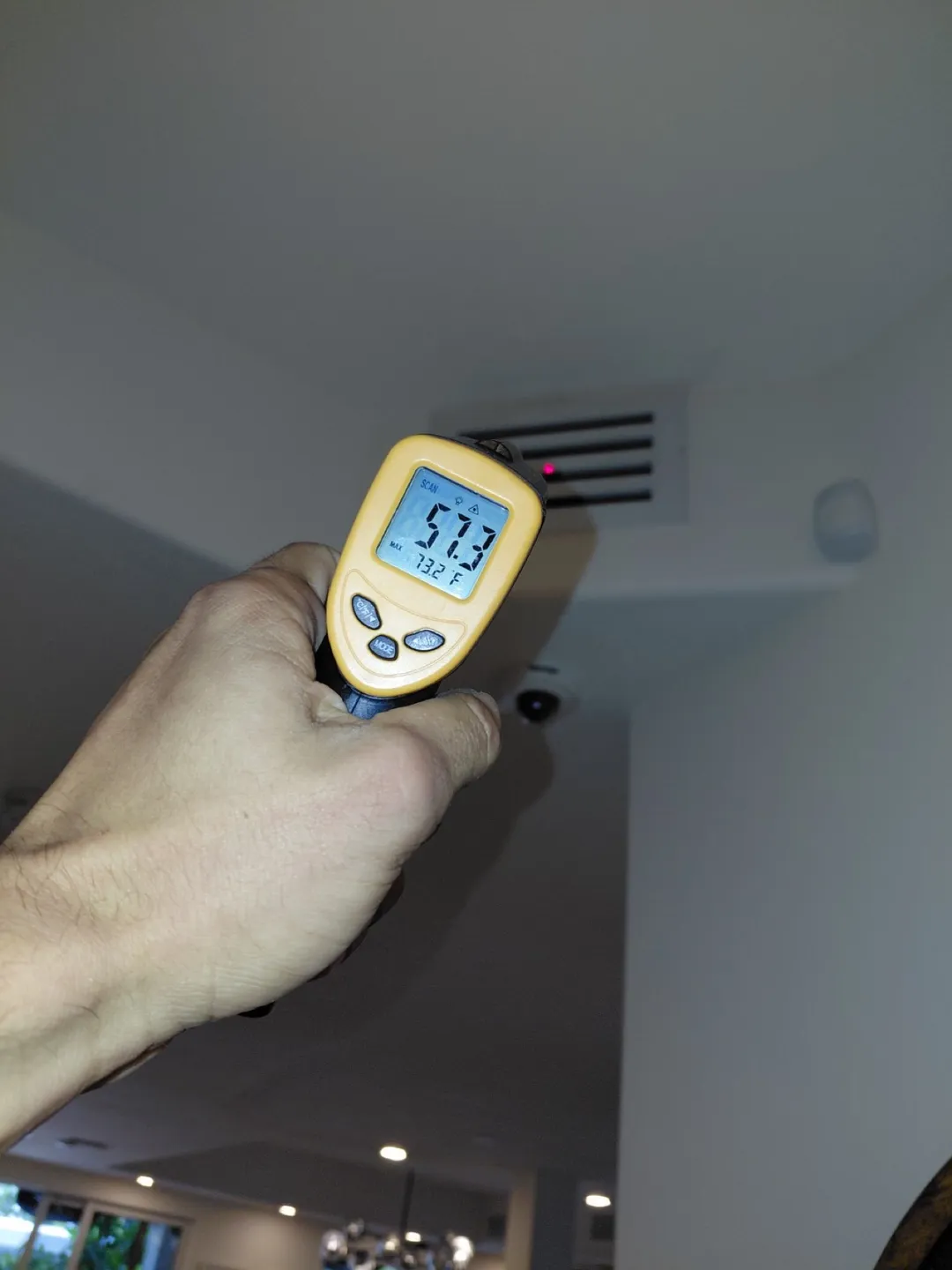
It is mid-afternoon, the thermostat has said 82 for an hour, and the vents are pushing air that barely feels cool. If you are reading this with a fan pointed at your face, you are having the most common AC day in South Florida. Here is the honest map: what you can check yourself in ten minutes, the nine causes behind almost every not-cooling call we take, and how to tell when the problem is not the AC at all.
First, check these 4 things yourself
Before anyone opens a toolbox, run these four checks. Ten minutes, all safe, and they genuinely fix a share of not-cooling calls.
- Thermostat settings and fan mode. Set it to Cool, a few degrees below the room temperature, and the fan to Auto - not On. On the On setting the fan blows between cycles, and that warm, humid air fools people into thinking the AC quit. Battery-powered? Try fresh batteries.
- The air filter. Pull it out and hold it up to the light. If you cannot see light through it, it is done. A clogged filter is the most common cause of weak cooling we find.
- The outdoor unit. The fan on top should be spinning, not just humming. Clear leaves, mulch, and anything stored against it, and give it two feet of open air. If the fan is not spinning at all, stop here and call.
- The breaker. Check the panel for a tripped breaker for the air handler or outdoor unit, and reset it once. If it trips again, do not keep resetting it - something electrical is asking for attention.
If those four check out and the house still warms up, the cause is inside the system. The version where it runs and runs but never gets cold has its own pattern - see our guide to an AC running but not cooling.
The 9 causes we find most
Nearly every not-cooling call here lands on one of these nine, in the order we find them, cheapest first.
1. Dirty filter and choked airflow
What it feels like: weak air at the vents, rooms that cool slowly, a system that never rests. The filter - and sometimes a coil or blower coated in buildup - strangles the airflow everything depends on. Left long enough, it causes cause number six.
2. Thermostat trouble
What it feels like: short runs, wrong room readings, cooling to a temperature nobody set. Thermostats catch hallway sun, lose calibration, or lose their batteries. Sometimes the AC is fine and the messenger is lying - a tech compares what it asks for against what the system does.
3. Low refrigerant - which means a leak
What it feels like: air that comes out cool but never cold, cooling fading a little each season, longer run times. Refrigerant is not used up; low charge means a leak. Topping it off without fixing the leak is a bill you pay again - we hunt the leak first, refill second.
4. A failed capacitor
What it feels like: sudden. Fine yesterday, gone today - often after a storm - with a hum outside where a running motor should be. The capacitor gives the motors their starting jolt, and Florida heat plus storm surges kill them fast. A small, quick repair if the compressor was not hurt.
5. Compressor trouble
What it feels like: the fan spins, the blower blows, the air stays warm. The compressor is the heart of the cooling side; weakened, it moves air without removing heat. It gets proven by testing, never assumed - often another cause is wearing a compressor costume.
6. A frozen evaporator coil
What it feels like: airflow fading over hours until almost nothing comes out. The coil freezes when air cannot cross it (cause one) or refrigerant runs low (cause three) - the cold builds ice instead. Turn it off and run the fan to thaw - the cause is still there. Thawing ice leaves puddles too - here is why an AC leaks water.
7. Duct leaks dumping cold air into the attic
What it feels like: the AC runs all day, the bill climbs, and the house holds degrees above the set temperature. The equipment makes cold air fine - the ducts deliver it to the attic instead. It gets its own section below.
8. Blower problems
What it feels like: some rooms get air, others almost none - or the whole house feels starved despite a clean filter. A worn motor, failing control, or a buildup-caked wheel all mean weak, uneven cooling. Bursts of start-stop air are a related pattern - see our guide to AC short cycling.
9. Electrical and control board faults
What it feels like: intermittent. Cooling quits and returns, breakers trip, the thermostat gets ignored. Everything routes through a control board, and South Florida adds power flickers, surges, and corrosion from salty air. Intermittent faults are the easiest to misdiagnose - they get tested, not theorized about.
Why it always happens on the hottest afternoon
It is not bad luck. A system is sized for a design temperature - roughly the hottest afternoon of a normal South Florida summer. Past it, a healthy system runs nearly nonstop just to hold the line, and a system with any weakness - a dirty coil, a tired capacitor, refrigerant a little low - has no reserve left. The weakness was there in May. July is when it sends the bill.
Humidity does the rest. A Florida system spends much of its power wringing moisture from the air before it can lower the temperature - so a struggling system feels clammy before it feels hot. Add afternoon storms, whose flickers surge through capacitors and trip electronics, and the recipe is complete: maximum load, maximum moisture, maximum electrical abuse, all at 3 PM.
When it's the ducts, not the AC
Here is the call that surprises people: the AC is fine, and the house still will not cool. Ducts run through a Florida attic that can hit 130 degrees or more on a summer afternoon. A duct split at a joint, crushed by stored boxes, or stripped of its insulation pours your cooled air into that attic and pulls hot attic air into the stream.
The air handler's moving parts can do the same thing: a coil and blower coated in years of buildup cannot move air at full strength, so even a strong system delivers a weak, warm-feeling stream. Second floors suffer first - if that is your pattern, our guide to a second floor that will not cool covers the upstairs version.
This is the part of the system we know best. A real air duct cleaning, with the ducts checked joint by joint, finds the leaks and crushed runs, and an AC coil and blower cleaning restores full airflow. When a "dying AC" turns out to be ducts and buildup, the fix is a cleaning and a repair - not a new system.
What we do when you call
We do not guess, and we do not start with a replacement quote. Our AC repair visit checks the whole path the cooling takes: thermostat, filter, coil, blower, refrigerant, outdoor unit, and a hands-on look at the ductwork. Then we show you exactly what we found - the actual part, the actual duct, the actual reading - and give you the exact price for your scenario in writing before any work begins. No obligation.
If your AC is not cooling, call or WhatsApp us at (954) 687-9356 or book your inspection below. In Florida heat, a system losing ground today is not winning it back tomorrow.
Frequently asked questions
Why is my AC running but not cooling?
Because moving air and removing heat are two different jobs. The blower can push air while the cooling side fails: a clogged filter or dirty coil chokes airflow, low refrigerant from a leak stops heat transfer, a worn capacitor idles the compressor, or leaking ducts dump cold air into the attic. Call (954) 687-9356.
Why is my AC not cooling below 78?
Partly physics: most systems are sized to hold roughly 20 degrees below the outdoor temperature, so at 97 outside, 78 inside can be a system at its design limit. The warning sign is change: if yours used to reach 74 and now stalls at 78, something shifted - a dirty coil, leaking refrigerant, or worsening duct leaks.
Can a dirty filter stop an AC from cooling?
Yes - it is the most common cause we find. A clogged filter starves the coil of air, cooling drops, run times stretch, and in bad cases the coil freezes solid and cooling stops completely. Swap in a clean filter and give it a few hours, letting any ice thaw with the fan running. If cooling does not return, the filter was only part of the story.
How do I know if it's the capacitor?
The signs: the outdoor unit hums but the fan or compressor struggles to start, cooling that died suddenly on a hot afternoon or after a storm. The capacitor stores the jolt that starts the motors, and Florida heat and surges wear them out fast. Confirming it is a technician check - it holds a charge even with the power off - and one of the smaller repairs.
Should I turn my AC off if it's not cooling?
Sometimes, yes. Turn it off and call if you see ice on the lines or coil, hear new grinding or buzzing, smell burning, or the breaker trips - running it then can turn a modest repair into a compressor replacement. If the air is still cool on a brutal afternoon, it can run while you do this guide's checks. But if it runs all evening without reaching the set temperature, shut it down.
Why can't you give me an exact repair price over the phone?
Because "AC not cooling" is a symptom, not a diagnosis - the nine causes here range from a filter you change yourself to a compressor at the end of its life, and the price depends on which is yours and what your home needs done. So we inspect first, show you exactly what we find, and give you the exact price in writing before any work, with no obligation. A phone number would be a guess - usually corrected later, upward.