In this article
Ask a roomful of South Florida homeowners how long an air conditioner should last and you will hear everything from "mine died at eight years" to "my neighbor's is twenty and still running." Both stories are real. Lifespan here is not a fixed number stamped on the unit - it is the outcome of our climate and how the system was cared for. This guide gives you the honest range, explains why Florida is unusually hard on AC equipment, and lays out the habits that separate the eight-year systems from the eighteen-year ones.
The honest answer: 10 to 15 years for many Florida systems
For many South Florida homes, a central AC lasts roughly 10 to 15 years. That is shorter than the figures often quoted nationally, and the reason is simple arithmetic: a Florida system runs far more hours per year than the same system almost anywhere else, and parts wear out by the hour, not by the birthday.
Where your system lands in that range depends on a short list of factors: how close you are to the coast (salt air), how well the system was sized and installed, how hard your home makes it work (insulation, duct condition, sun exposure), and - the factor you control most - how it has been maintained. A neglected coastal system can be effectively done before year ten. A maintained system in the same neighborhood can still be cooling respectably at fifteen and beyond.
Why Florida is so hard on air conditioners
- Runtime. Cooling season here is most of the year. Compressors, fan motors, and capacitors accumulate hours at a pace northern systems never see.
- Humidity load. Cooling Florida air means wringing water out of it constantly. That moisture lives on the coil, in the drain pan, and in the condensate line - exactly where algae and biofilm love to grow, and exactly where clogs cause water damage and shutdowns.
- Salt air corrosion. Near the ocean - and most of Broward, Palm Beach, and Miami-Dade counts as near - salt mist eats outdoor coil fins and electrical connections. Corroded fins transfer heat poorly, so the system runs longer, so it wears faster. The loop is unforgiving.
- Heat itself. Electrical parts age faster hot. Capacitors, the small parts that help motors start, are famous for weakening through Florida summers and failing on the first extreme day they are asked to work hardest.
- Storm season. Power flickers and surges during storms stress controls and motors in ways a calm climate never does.
The habits that add years to a system
None of this is exotic. The systems that outlive the range share the same few habits:
- Regular maintenance. A professional checkup at least once a year - twice for older systems, coastal homes, and homes with pets. It catches the weakening capacitor, flushes the drain line before it clogs, and documents the system's condition. Our Florida AC maintenance guide lays out the full checklist and the spring-and-fall rhythm.
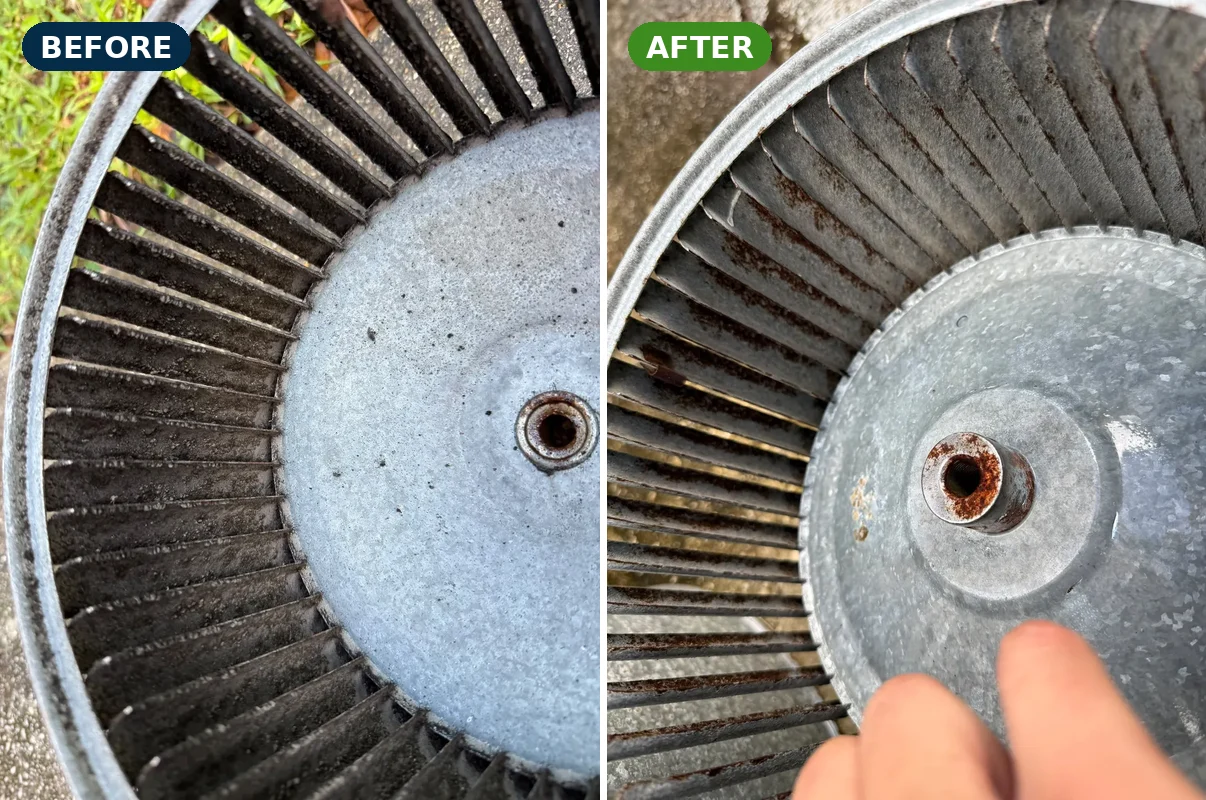
- Cleaning when buildup appears. A coil insulated with grime and a blower wheel packed with buildup force the whole system to run longer for the same cooling, every single day. A professional coil and blower cleaning restores airflow and heat transfer, taking that daily strain back off the compressor. Most Florida homes need it every 1 to 2 years.
- Filter discipline. A fresh filter every 1 to 2 months in cooling season is the cheapest life-extender there is. A clogged filter starves airflow and can contribute to frozen coils.
- Breathing room outside. Keep the outdoor unit clear of plants and debris so it can shed heat, and rinse visible dust off the coil gently with a hose.
- Fixing small things small. Water near the air handler, new noises, a room that stopped cooling evenly - each is a cheap fix today and a system-killer if it rides for a season. Our guide to an AC that runs but does not cool helps you read those signs early.
Signs your AC is nearing the end
Age alone does not retire a system, but age plus these signs should start the conversation:
- Repairs are becoming a yearly habit, and the quotes are getting bigger, not smaller.
- Bills climb while comfort falls - the system runs longer and the house still never quite gets there.
- Uneven cooling that a cleaning and checkup do not fix.
- Visible corrosion on the outdoor coil, or a compressor that is loud, hard-starting, or short-cycling.
- An older refrigerant. Systems built around R-22 face scarce, expensive refrigerant and parts, which changes the repair math quickly.
Repair, clean, or replace: how to decide
Work through it in order. First, make sure the system is clean and properly checked - more than a few "dying" ACs turn out to be healthy systems suffocating under buildup, and a cleaning plus maintenance visit brings them back. Second, if a repair is needed, get it priced exactly, in writing, alongside the system's honest condition in photos. Third, weigh that price against the system's age and history: a modest repair on a maintained 11-year-old that cools well can be money well spent, while a major repair on a struggling 13-year-old usually is not. When replacement is the right call, our AC installation team will size and price it properly - and when repair is right, our AC repair team will tell you that instead. Either way, the decision should be yours, made with real numbers in front of you.
A simple care timeline by system age
- Years 0 to 5: filters on schedule, one maintenance visit a year, drain line kept clear. Most systems need nothing more.
- Years 5 to 10: keep the yearly checkup, add a coil and blower cleaning when the inspection shows buildup, and watch the drain line and capacitor closely - this is when neglect starts compounding.
- Years 10 and up: consider the twice-a-year rhythm, keep every maintenance report, and start a quiet replacement fund so a failure is a plan, not an emergency. A system this age that still cools well after a cleaning is worth maintaining - one that does not is telling you something.
Not sure where your system stands? Book an inspection through the homepage form or call (954) 687-9356. We will show you what we find, in photos, give you exact prices for every option, and tell you honestly whether your AC has years left in it. We serve Broward, Palm Beach, and Miami-Dade, 7 AM to 8 PM, every day.
Frequently asked questions
What is the average lifespan of an AC unit in South Florida?
For many systems, roughly 10 to 15 years. The same equipment often lasts longer in cooler states because it runs far fewer hours. Coastal homes with salt air and no maintenance routine tend to land at the short end of the range; well-maintained inland systems regularly reach the long end and beyond.
Does regular maintenance really extend AC life?
Yes. Maintenance catches the small failures that cascade - a weakening capacitor, a clogging drain line, a dirty coil forcing longer runtimes - before they strain the compressor and other major parts. It also keeps efficiency from sliding, so the system does the same cooling job with less work every day.
Is it worth repairing a 12-year-old AC?
Sometimes. A modest repair on a system that still cools well and has been maintained can buy several good years. A major repair - especially a compressor - on a system that already struggles usually makes replacement the smarter money. The right way to decide is with exact written prices for both paths and photos of the system's actual condition, which is what we give you.
When should I start budgeting for a replacement?
Once the system passes about 10 years and repairs start becoming a yearly event, begin planning rather than reacting. A planned replacement, chosen on your schedule, almost always goes better - and costs less in stress - than an emergency one during a heat wave.